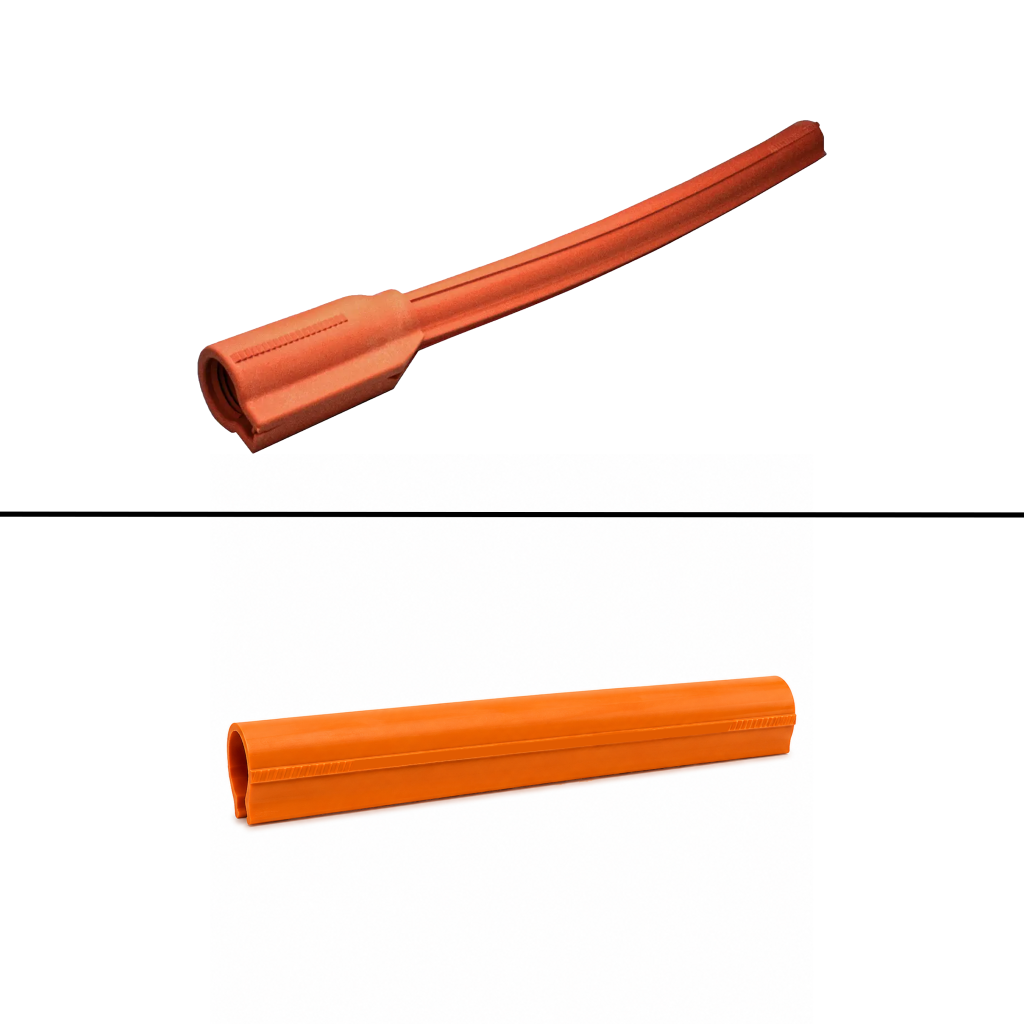
Flexible rubber line hoses are fundamental cover-up equipment used by line crews to temporarily isolate energized overhead conductors, jumper wires, and crossarm connections. Because line hoses are continually dragged up poles, flexed, and clamped onto rough conductors, physical abrasion, ozone cutting, or hidden punctures can compromise their electrical insulating capability.
Burlington Safety Laboratory provides comprehensive, ASTM-compliant dielectric testing services for utility line hose across our laboratory facilities in New Jersey and California. With our standard 2-week turnaround time (and expedited options available), we ensure your overhead protective cover-up equipment meets strict electrical safety standards.
Why Choose Burlington Safety Lab for Line Hose Testing?
- NAIL for PET Accredited: Certified independent laboratory testing since 1971.
- Full ASTM / OSHA Compliance: Tested strictly to ASTM D1050 and F478 standards.
- Seamless Replacement Program: New product inventory ready to replace failed line hose immediately.
- Complete Traceability: Detailed test documentation, ink date stamping, and serialized record-keeping provided with every order.
Line Hose Compliance & Testing Specifications
To remain compliant with OSHA 1910.137 and NFPA 70E, rubber insulating line hose must undergo dielectric laboratory testing every 12 months (or sooner if visual field inspection indicates potential damage).
Spec Feature | Standard Specification Details |
|---|---|
Applicable Standards | ASTM D1050 (Manufacturing) & ASTM F478 (In-Service Care/Testing) |
Line Hose Classes Tested | Class 0 (1,000V) through Class 4 (36,000V) — Straight, Connector End, & Extended Lip |
Required Test Frequency | Every 12 months (In-Service) / 12 months (Unissued/Stored) |
Accreditation | NAIL for PET (North American Independent Laboratories for Protective Equipment Testing) |
Turnaround Time | Standard 2-Week Turnaround (Expedited Services Available) |
Our Step-by-Step Dielectric Testing Process for Line Hose
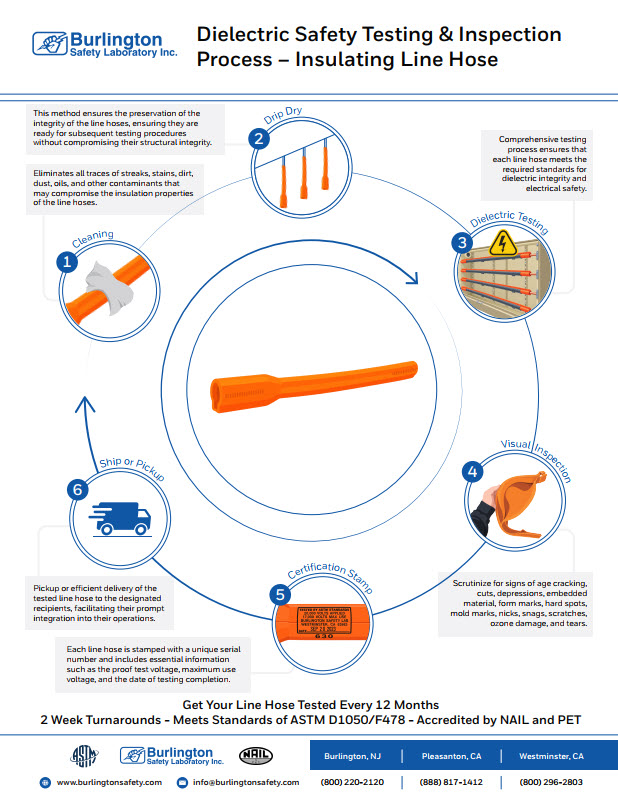
Every piece of rubber insulating line hose submitted to Burlington Safety Laboratory passes through a rigorous quality assurance workflow:
Step 1: Preparatory Cleaning & Washing
Line hoses are thoroughly washed inside and out using specialized, non-degrading cleaning agents to eliminate dirt, oil, grease, tree sap, asphalt residue, and line oxidation. Old test stamps and markings are removed to allow for clean re-stamping.
Step 2: Machine Drying
After washing, line hoses pass through controlled warm-air dryers to completely dry internal and external surfaces prior to high-voltage testing.
Step 3: Dielectric High-Voltage Testing
Line hoses are submerged or mounted in precision high-voltage testing tanks in strict adherence to ASTM standards. Our automated testing units apply the required proof-test voltage based on the line hose class (Class 0 through Class 4) while monitoring leakage current. Any hose displaying dielectric breakdown or excessive electrical leakage is automatically flagged.
Step 4: Re-Drying Process
Following liquid-immersion dielectric testing, line hoses undergo a second warm-air drying cycle before moving to visual and physical evaluation.
Step 5: Visual Inspection & Physical Evaluation
Skilled technicians spread and inspect the full length of each line hose inside and out. Technicians check the inner lip, outer surface, and connecting ends under proper lighting for defects including:
- Corona cutting, ozone cracking, and UV degradation
- Deep scratches, gouges, cuts, punctures, or embedded wire strands
- Chemical deterioration, soft spots, hard spots, or permanent structural warping
Step 6: Serialized Stamping
Line hoses that pass dielectric and visual inspections are stamped in durable ink with a unique tracking serial number, test completion date, proof-test voltage, and maximum use voltage rating.
Step 7: Packaging & Protective Handling
Certified line hoses are bundled straight or supported in protective packaging to prevent creasing, pinching, or mechanical deformation during transport.
Step 8: Boxing & Labeling
Hoses are placed in heavy-duty protective cartons or containers, sealed with Burlington Safety tape, and tagged with detailed box labels displaying serial numbers and test dates.
Step 9: Shipping or Pickup
Completed orders are dispatched via UPS/freight or made available for customer pickup at one of our regional facilities (Burlington, NJ; Pleasanton, CA; Westminster, CA).
Line Hose Field Care & Inspection (In the Field Guidelines)
Proper daily field practices extend the operational life of rubber insulating line hose and ensure safety between required 12-month laboratory retests:
ALWAYS:
NEVER:
Immediate Replacement for Failed Line Hose
If a line hose fails dielectric testing or physical inspection, safety regulations require it to be taken out of service permanently.
Burlington Safety Laboratory maintains a comprehensive stock of new, freshly tested Class 0 through Class 4 rubber line hoses (straight, conventional, and lip-lock styles) in various diameters and lengths. We can instantly fulfill replacement orders from stock so your crews maintain full cover-up protection without project downtime.
Ready to Recertify Your Line Hose?
Ensure your utility workers stay protected against accidental re-energization with certified electrical testing.