
Temporary protective grounding cable sets and insulated jumpers are critical lifelines for utility crews, providing de-energized line protection and electrical bypass capabilities. Because these assemblies endure extreme mechanical stress, flexing, weather exposure, and potential fault current surges, hidden wire strands or damaged clamps can cause catastrophic failure during an unexpected energization event.
Burlington Safety Laboratory delivers complete, ASTM-compliant testing and inspection services for temporary grounding equipment and insulated jumpers across our lab facilities in New Jersey and California. With our standard 2-week turnaround time (and expedited options available), we ensure your grounding gear and bypass equipment deliver full fault-current protection when your crews need it most.
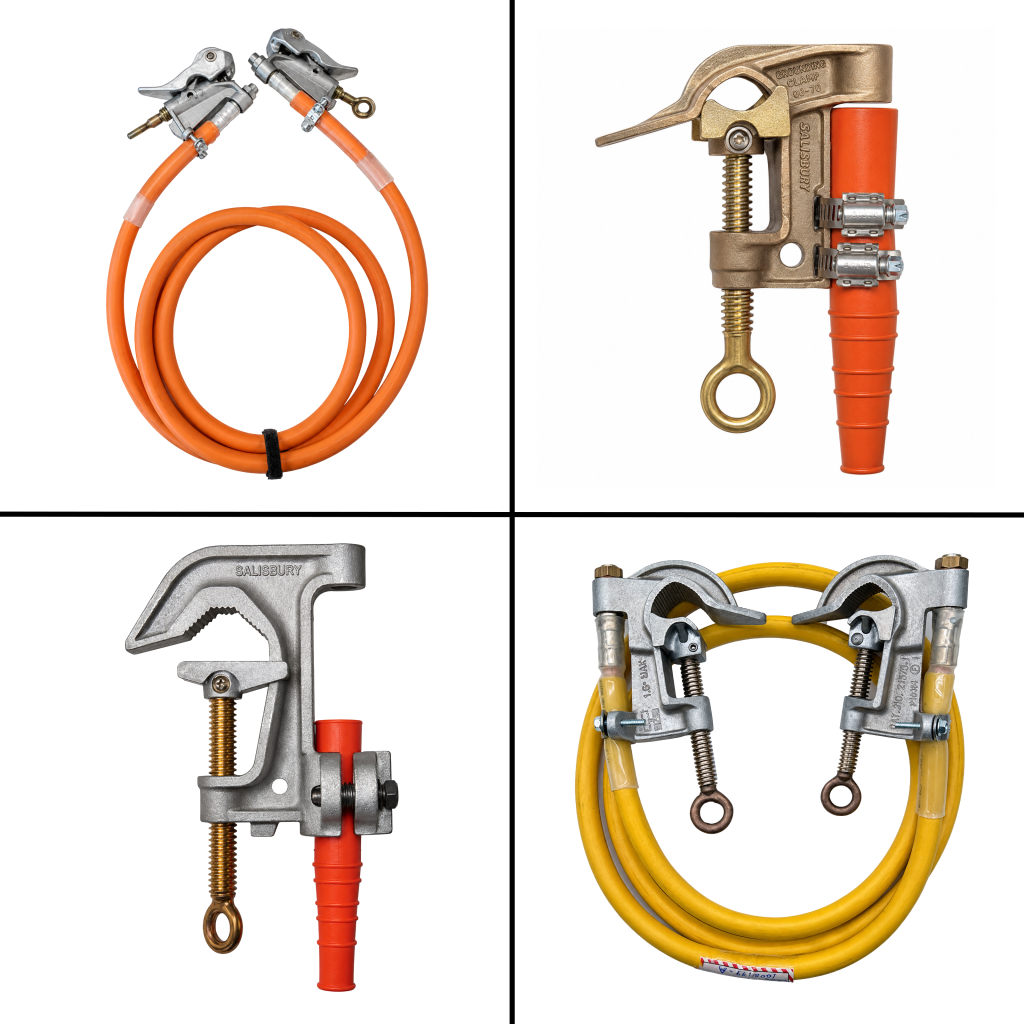
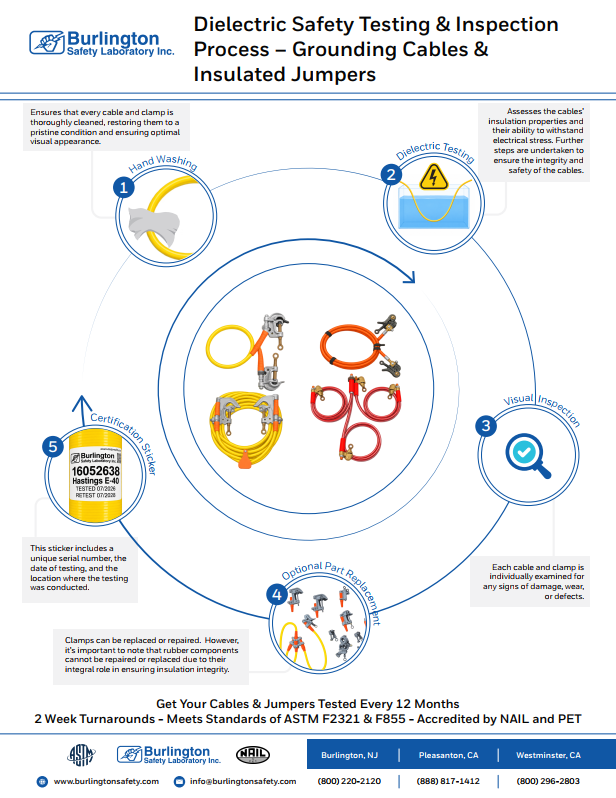
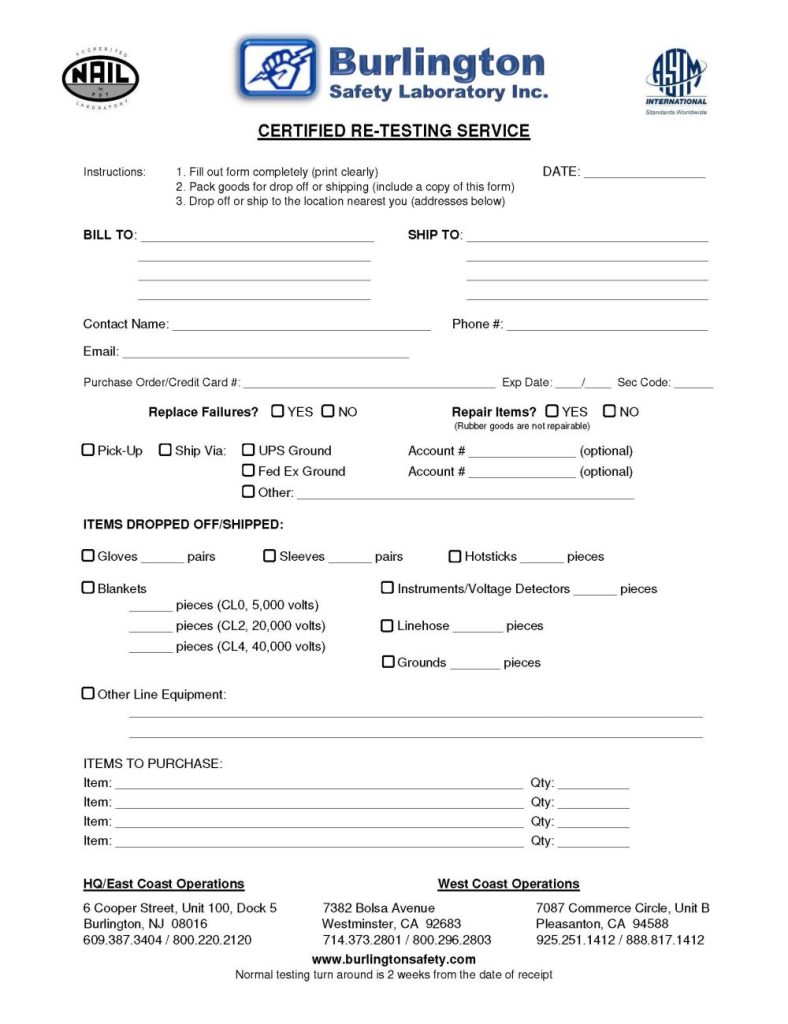
Why Choose Burlington Safety Lab for Grounding & Jumper Cable Testing?
- NAIL for PET Accredited: Certified independent laboratory testing since 1971.
- Full ASTM / OSHA Compliance: Tested strictly to ASTM F855 (Grounding) and ASTM F2321 (Jumpers) standards.
- Comprehensive Resistance & Voltage Drop Testing: High-current micro-ohm testing to detect hidden internal strand breakage.
- Complete Traceability: Detailed test reports, serialized tracking, and ink stamping provided with every assembly.
Grounding & Jumper Cable Compliance & Testing Specifications
To comply with OSHA 1910.269(n) and NFPA 70E, temporary grounding sets and insulated jumper cables must undergo regular laboratory electrical testing and visual inspection every 12 to 24 months (or after any fault current exposure).
Spec Feature | Standard Specification Details |
|---|---|
Applicable Standards | ASTM F855 (Grounding Sets) & ASTM F2321 (Insulated Jumpers) |
Assemblies Tested | Single/multi-ground sets, cluster grounds, substation grounds, insulated jumpers (15kV–35kV) |
Required Test Frequency | Every 12 months (Jumpers – F2321) / Every 2 years (Grounds – F855) / Post-Fault |
Accreditation | NAIL for PET (North American Independent Laboratories for Protective Equipment Testing) |
Turnaround Time | Standard 2-Week Turnaround (Expedited Services Available) |
Our Step-by-Step Dielectric Testing Process for Grounding & Jumper Cables
Every temporary grounding set and insulated jumper submitted to Burlington Safety Laboratory undergoes a thorough multi-point evaluation:
Step 1: Preparatory Cleaning & Decontamination
Grounding clamps, ferrules, cable jackets, and jumper insulation are cleaned to remove dirt, grease, oxidation, corrosion, and road grime. Removing surface oxidation from clamp jaws and ferrules is essential for achieving accurate electrical resistance readings.
Step 2: Drying & Surface Prep
Following cleaning, jumper cables and grounding assemblies undergo controlled drying to prepare the insulating jacketing and connection hardware for electrical testing.
Step 3: High-Current Resistance & Voltage Drop / Dielectric Testing
- Grounding Sets (ASTM F855): Assemblies undergo high-current micro-ohm resistance and voltage-drop testing across the entire assembly—from clamp jaw to clamp jaw. This pinpoints broken copper strands, loose ferrules, or corroded connections that visual inspection alone cannot reveal.
- Insulated Jumpers (ASTM F2321): Jumpers undergo both voltage-drop/resistance testing and high-voltage dielectric insulation testing to verify jacket integrity and phase-to-ground isolation.
Step 4: Secondary Drying Cycle
Assemblies pass through a drying phase following water-bath or solvent cleaning processes prior to final physical inspection.
Step 5: Visual Inspection & Hardware Mechanical Check
Technicians perform a complete physical tear-down inspection of all components:
- Cable Jacket & Copper Strands: Inspected for swelling, cuts, severe abrasions, swollen jackets, or broken copper wire strands at ferrule strain reliefs.
- Clamps & Ferrules: Checked for stripped threads, cracked castings, bent eyescrews, damaged alignment pins, or loose crimp connections.
- Jumper Heads & Valves: Inspected for proper mechanical operation and smooth jaw movement.
Step 6: Serialized Stamping & Identification
Assemblies passing electrical and physical testing receive durable serialization stamps/tags displaying the unique tracking serial number, test date, and voltage/fault rating.
Step 7: Packaging & Protective Wrapping
Grounding sets and jumpers are coiled properly (preventing tight bends) and wrapped in protective covers to shield clamps and cable jackets during transport.
Step 8: Boxing & Labeling
Assemblies are packed in durable heavy-duty cartons or crates, sealed with Burlington Safety tape, and affixed with tracking labels.
Step 9: Shipping or Pickup
Completed orders are shipped via UPS/freight or made available for customer pickup at one of our regional lab facilities (Burlington, NJ; Pleasanton, CA; Westminster, CA).
Grounding & Jumper Cable Field Care & Inspection (In the Field Guidelines)
Proper daily handling and care keep temporary grounding sets and insulated jumpers reliable between required lab retest intervals:
ALWAYS:
NEVER:
Immediate Replacement & Custom Assembly Fabrication
If a grounding set or jumper cable fails resistance/dielectric testing or shows severe mechanical wear, it must be removed from service immediately.
Burlington Safety Laboratory provides complete fabrication and replacement services:
- Custom Ground Set & Jumper Assembly: Custom-built grounding sets and jumpers fabricated in-house to your exact length, clamp, and cable size requirements (1/0 to 4/0 copper).
- Replacement Parts: Stocked clamps, ferrules, clear/yellow cable jackets, strain-relief sleeves, and hardware from leading manufacturers.
Ready to Recertify Your Grounding & Jumper Sets?
Ensure your utility workers stay protected against accidental re-energization with certified electrical testing.