
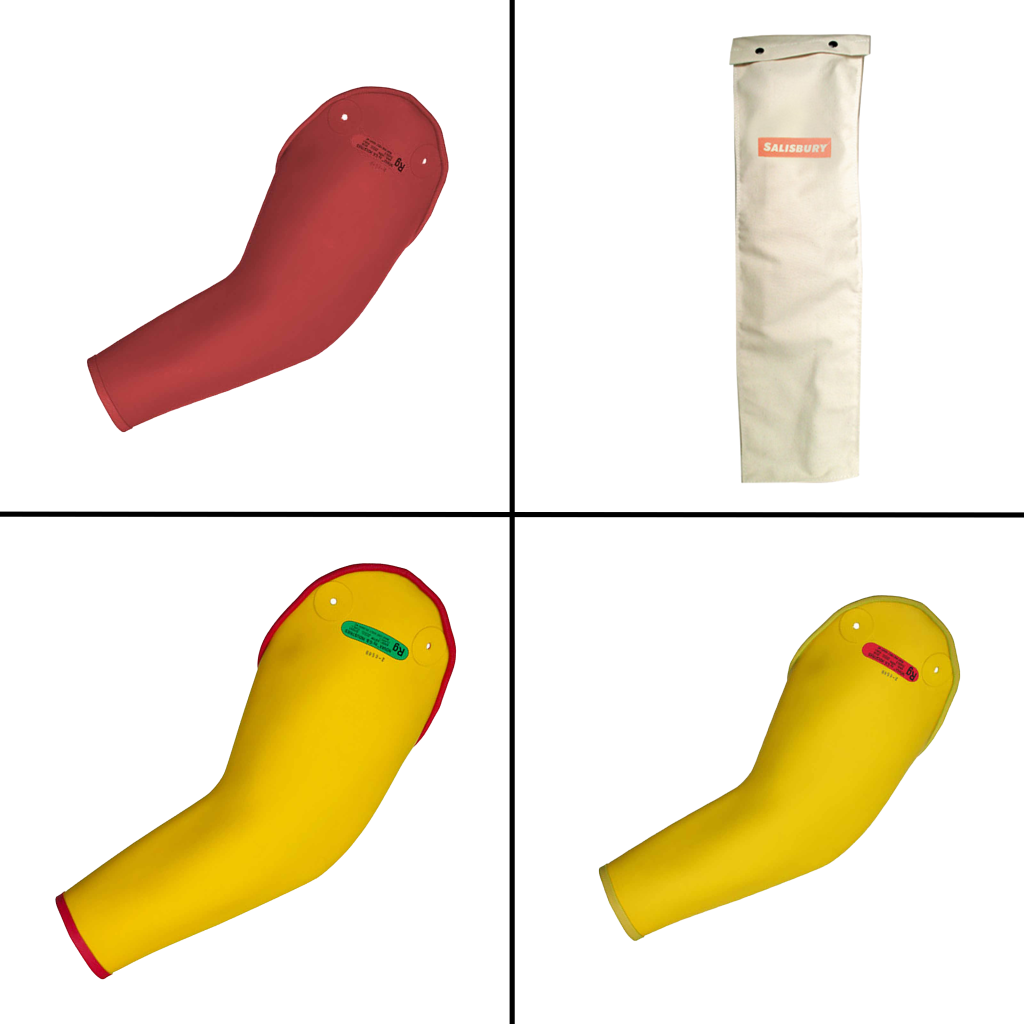
Rubber insulating sleeves protect a lineman’s arms and shoulders from accidental contact with energized conductors and electrical apparatus. Because sleeves operate in high-stress, high-friction environments, regular testing is critical to verify their dielectric integrity and prevent life-threatening electrical shock or arc flash incidents.
Burlington Safety Laboratory offers complete, ASTM-compliant testing services for electrical safety sleeves across our state-of-the-art testing facilities in New Jersey and California. With our standard 2-week turnaround time (and expedited options available), we keep your utility line crews and electrical contractors safe and fully compliant.
Why Choose Burlington Safety Lab for Rubber Sleeve Testing?
- NAIL for PET Accredited: Certified independent laboratory testing since 1971.
- Full ASTM / OSHA Compliance: Tested strictly to ASTM D1051 and F496 standards.
- Seamless Replacement Program: New product inventory ready to replace failed sleeves immediately.
- Complete Traceability: Detailed test documentation, ink date stamping, and serialized record-keeping provided with every order.
Rubber Safety Sleeve Compliance & Testing Specifications
To comply with OSHA 1910.137 and NFPA 70E, rubber insulating sleeves must undergo dielectric laboratory retesting every 12 months (or every 6 months depending on individual utility or safety program requirements).
Spec Feature | Standard Specification Details |
|---|---|
Applicable Standards | ASTM D1051 (Manufacturing) & ASTM F496 (In-Service Care/Testing) |
Sleeve Classes Tested | Class 00 (500V) through Class 4 (36,000V) |
Required Test Frequency | Every 12 months (In-Service) / 12 months (Unissued/Stored) |
Accreditation | NAIL for PET (North American Independent Laboratories for Protective Equipment Testing) |
Turnaround Time | Standard 2-Week Turnaround (Expedited Services Available) |
Our Step-by-Step Dielectric Testing Process for Rubber Sleeves
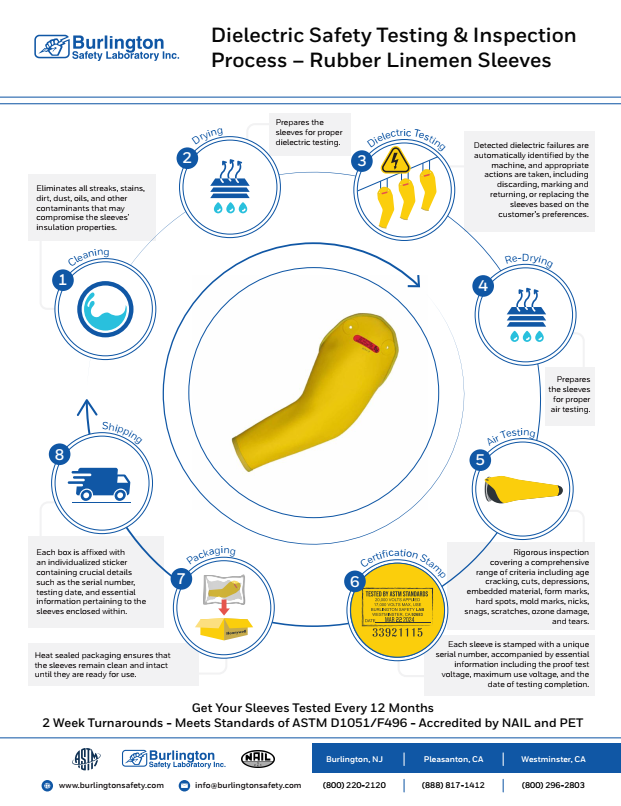
Every pair of rubber insulating sleeves submitted to Burlington Safety Laboratory passes through a rigorous quality assurance workflow:
Step 1: Preparatory Cleaning & Washing
Sleeves undergo thorough cleaning in accordance with ASTM standards to remove dirt, grease, oils, chemicals, and contaminants that can compromise dielectric properties. Large batches are cleaned using industrial cruise-line washing equipment, while smaller lots use commercial washers. Old test stamps and markings are removed to ensure accurate evaluation.
Step 2: Machine Drying
Following the washing phase, sleeves undergo a controlled warm-air drying process to prepare them for precision electrical testing.
Step 3: Dielectric High-Voltage Testing
Utilizing specialized high-voltage testing machines, sleeves are loaded into water tanks and subjected to dielectric testing adhering to ASTM standards. Our advanced equipment simultaneously measures dielectric strength and leakage current across all voltage classifications (Class 00 through Class 4). Any detected dielectric breakdown or leakage failure is automatically identified and isolated.
Step 4: Re-Drying Process
After completing the water bath dielectric testing, sleeves undergo a second round of warm-air drying to prepare for physical visual inspection.
Step 5: Visual Inspection & Physical Evaluation
Our skilled technicians perform a meticulous visual inspection of each sleeve inside and out. Technicians manually stretch and examine the rubber to detect physical defects, including:
- Corona cutting, ozone damage, and UV degradation
- Cuts, nicks, snags, scratches, and punctures
- Hard spots, form marks, chemical deterioration, or embedded material
Step 6: Serialized Stamping
Sleeves that pass both electrical and physical visual inspections are stamped in durable ink with a unique serial number, the proof test voltage, maximum use voltage, and testing completion date for complete traceability.
Step 7: Individual Bag Packaging
Each certified pair of sleeves is heat-sealed in an individual plastic bag to shield the rubber from contaminants, moisture, and mechanical damage during transit and storage.
Step 8: Boxing & Labeling
Sleeves are carefully placed into boxes and sealed with Burlington Safety tape. Each box receives an individualized sticker containing the serial numbers, test date, and pertinent product specifications.
Step 9: Shipping or Pickup
Sealed shipments are dispatched to the customer via UPS or made available for customer pickup at one of our regional facilities (Burlington, NJ; Pleasanton, CA; Westminster, CA).
Rubber Sleeves Field Care & Inspection (In the Field Guidelines)
Proper daily care extends the lifespan of rubber insulating sleeves and ensures maximum protection between required laboratory retests:
ALWAYS:
NEVER:
Immediate Replacement for Failed Sleeves
If a sleeve fails dielectric voltage testing or visual inspection, safety regulations require it to be removed from service immediately.
Burlington Safety Laboratory maintains a complete inventory of new, freshly tested Class 00 through Class 4 rubber insulating sleeves (dipped or molded, straight or curved) from top manufacturers. We can immediately replace rejected items from stock so your crew suffers zero operational downtime.
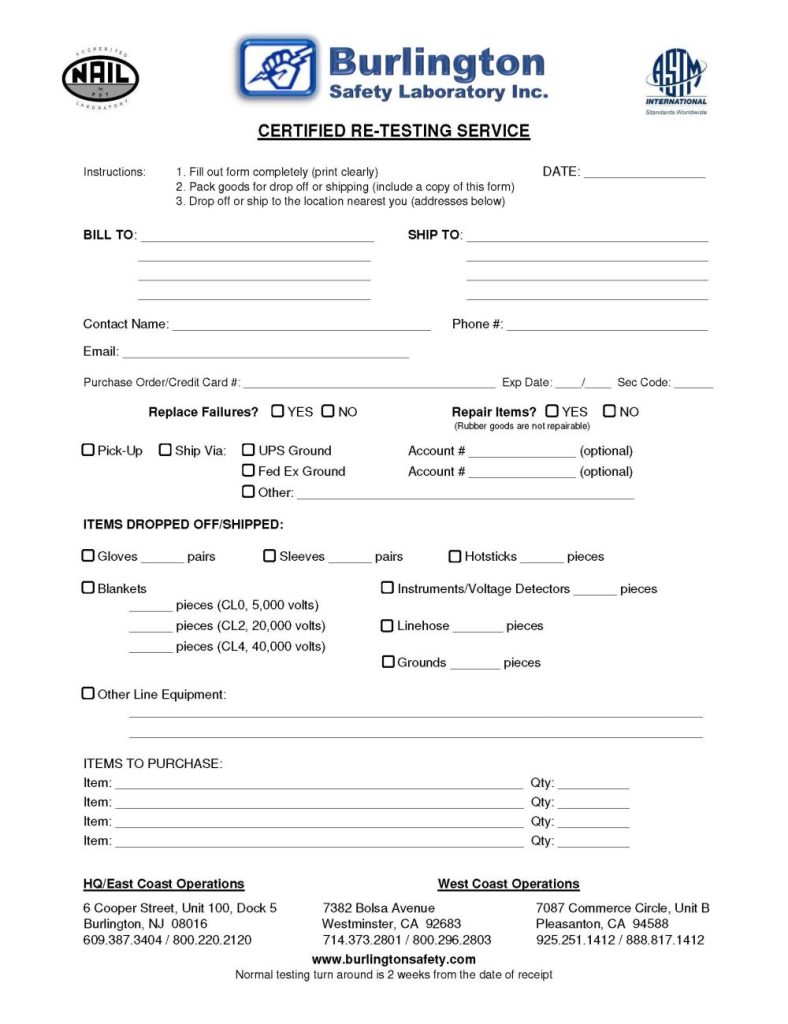
Ready to Recertify Your Electrical Sleeves?
Ensure your line workers stay protected and fully compliant with OSHA and ASTM guidelines.